
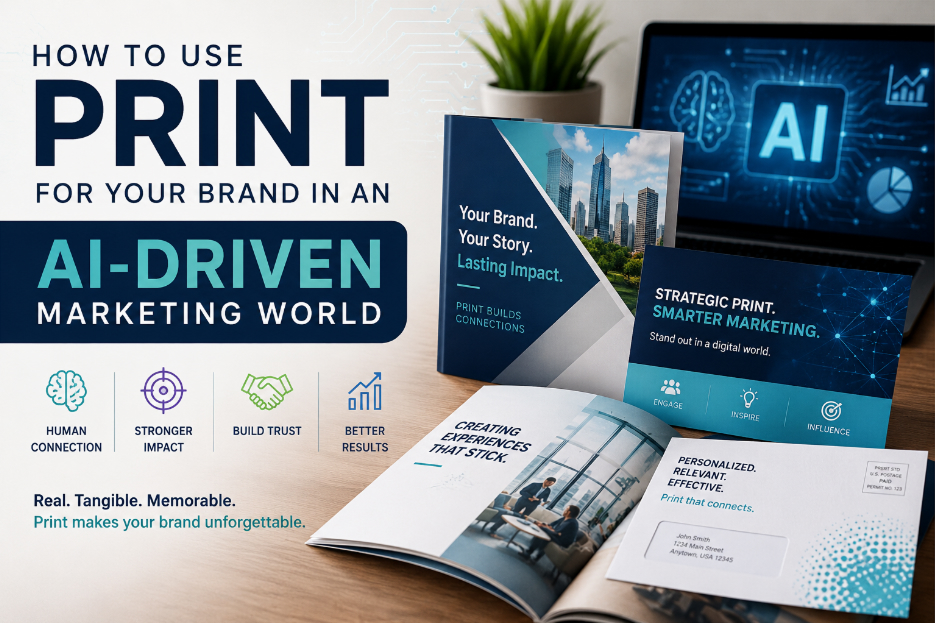
Artificial intelligence is changing marketing fast. Businesses now use AI to write emails, generate ads, create social media posts, build landing pages, and automate customer communication. While that creates efficiency, it also creates a new challenge: much of today’s marketing is starting to look and sound the same.
Consumers are overwhelmed with digital content. Social media feeds are crowded with junk, while AI-generated ads and emails compete for attention every second of the day. As digital marketing becomes more automated, physical print has become more valuable because it feels more real, more credible, and harder to ignore.
That doesn’t mean print replaces digital marketing. The strongest brands use print and digital together.
Here is how businesses are using print effectively in an AI-driven marketing environment.
Use Print To Create Attention That Digital Can’t
Digital content is easy to skip. People quickly scroll past ads, delete emails, and ignore pop-ups almost automatically.
Printed materials create a different experience. You can’t delete a brochure, postcard, catalog, direct mail piece, or presentation folder. Sure, you can throw it in the trash, but you generally have to pick it up first. While you do, you probably read it first to confirm whether or not you should discard it. That tactile experience of holding the piece and touching its paper, ink, and finish creates more of a durable impression in the mind.
When you physically handle a printed piece, several things happen at once:
* Your brain shifts from passive viewing to active interaction
* Multiple senses become involved
* The material occupies physical space
* The interaction slows down your decision-making
* Your brain processes the object as more “real” and permanent
That tactile interaction is important. Research from Temple University, the USPS Office of Inspector General, Canada Post, and neuromarketing studies has shown that physical media activates more areas of the brain associated with emotional processing, memory formation, and value assessment than digital media alone.
Consumers are increasingly skeptical of automated online messaging, but print helps your brand feel established and trustworthy.
Use Print to Support Digital Campaigns
The best marketing campaigns no longer operate in separate channels. Print works best when it connects directly with your digital marketing efforts.
For example:
- A postcard campaign can drive traffic to a customized landing page
- A brochure can include QR codes linked to videos or product demonstrations
- Event signage can promote social media hashtags
- Direct mail can support retargeting campaigns on Google and Meta
- Printed packaging inserts can encourage online reviews or repeat purchases
This type of integration helps businesses stay visible across multiple touchpoints instead of relying on a single ad or email.
A printed piece often becomes the bridge that moves customers from physical engagement into digital action.
Use Variable Data Printing To Make Your Print More Personal
One advantage AI has introduced into marketing is personalization. Customers now expect relevant messaging.
Modern printing technology allows brands to personalize printed materials in many of the same ways digital marketing platforms personalize online content. Variable data printing allows businesses to customize:
- Names
- Locations
- Product recommendations
- Promotional offers
- Industry-specific messaging
- Customer imagery
- Personalized URLs
- QR codes
For example, a healthcare provider in Ventura might send different messaging to families, seniors, or business professionals. A university in Santa Barbara may personalize donor appeals based on alumni interests or graduation year. This makes print campaigns feel more relevant and less generic.
Use Print To Make Your Brand Stand Out in an AI-Saturated Marketplace
AI tools are making content production faster, but speed alone does not create differentiation.
Businesses now face a growing problem where websites, emails, ads, and social media posts often sound nearly identical. Customers can sense when content feels automated or mass-produced.
Print slows the interaction down.
Paper quality, design, finishing techniques, photography, texture, and packaging all contribute to how people perceive your brand. A professionally printed piece communicates effort and investment in a way digital impressions often cannot.
That is especially important for industries where trust matters:
- Healthcare
- Education
- Financial services
- Real estate
- Manufacturing
- Legal services
- Nonprofits
- Luxury retail
Print gives businesses a chance to create a stronger physical brand experience while competitors focus entirely on digital automation.
Use Large Format Printing To Dominate Your Physical Visibility
Even in an AI-driven world, physical environments still influence buying decisions every day. Businesses continue to rely heavily on:
- Trade show displays
- Building signage
- Window graphics
- Outdoor banners
- Wall murals
- Event graphics
- Retail displays
- Fleet graphics
These applications create visibility that digital advertising alone cannot replicate. A digital ad disappears in seconds. A storefront sign or event display may generate impressions continuously for months or years.
For brands investing heavily in digital advertising, physical print environments help reinforce recognition and credibility.
Use Print To Build Trust
One reason print remains effective is psychological. People often associate printed materials with legitimacy and stability.
Anyone can create an AI-generated website or social media account in minutes. Professionally printed marketing materials require planning, production, and investment. That distinction influences perception.
A high-quality booklet, annual report, catalog, or direct mail package signals that a company is established and serious about its brand.
This is one reason many successful businesses continue investing in print even while increasing their digital marketing budgets.
Understand That The Future of Marketing Is Integrated, Not Digital-Only
AI will continue reshaping marketing. Automation, personalization, and content generation will keep expanding. But the brands that stand out will not rely on digital marketing alone.
Successful companies are combining AI-driven efficiency with physical marketing experiences that feel authentic, memorable, and human. Print remains one of the most effective ways to create that connection.
When integrated properly with websites, email marketing, social media, digital advertising, and customer data, print becomes more than a marketing piece. It becomes part of a larger brand experience that customers remember long after a digital impression disappears.